
Home > Advanced search > Objects > Verona Vendetta
Verona Vendetta
Jan Kath
2011
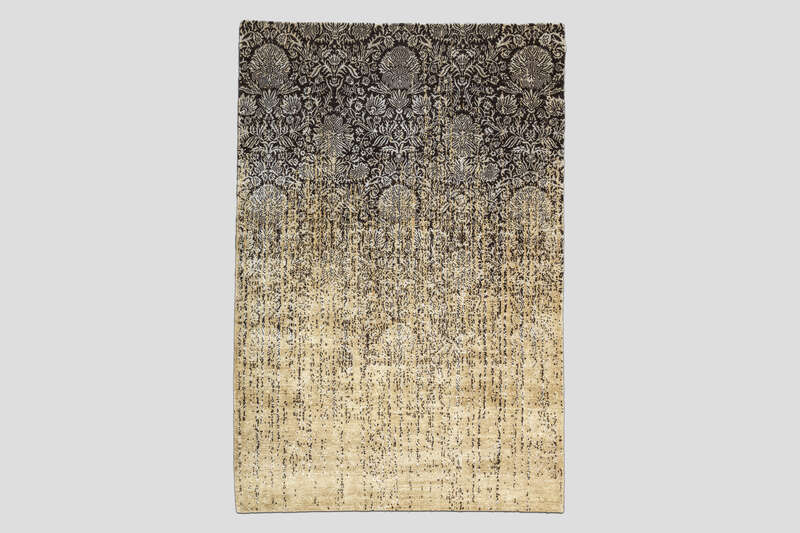
The title of this carpet refers both to Verona as a city in northern Italy and to a vendetta (the Italian word for “blood feud”) as a design effect. Jan Kath uses the latter as a twist on the arabesque: a classical Italian textile pattern consisting of equally spaced stylized blossoms and vines facing in the same direction. Three materials were woven together in even parts to create the yarns used in the ornamentation: soft Tibetan highland wool, fine Chinese silk, and lustrous, robust Nepalese nettle (Girardinia diversifolia or allo sisnu). The combination lends the pile a variable structure and feel. The repeated pattern is interrupted in places by strips of golden-yellow silk that widen over the lower two thirds of the carpet. As a floor covering, the design can be interpreted in one of two ways: either the strips appear to emerge from a dense mass and run down over the other half of the carpet, or the strips grow thicker as they move from one side to the other. But regardless of the direction from which the floral pattern is viewed, it appears to dissolve. The golden strips “erase” the classical pattern as a kind of artistic vigilante justice, whereby any form of resistance seems futile. The design thus refers to Erased Classic, the title of the commercial series to which Verona Vendetta). belongs. In this collection, which can be considered a milestone in Kath’s oeuvre, he breaks through old patterns of perception. The series consists of a number of handmade carpet designs whose motifs allude to the deconstruction of classical textile patterns as well as the abstraction of their decorative elements. What we are witnessing here is an incipient metamorphosis into new and unusual forms of design. As with the rug Alcaraz Sky, Kath is responding not only to the role of ornamentation here but also to the function it fulfills in the self-determination of art, i.e. with respect to aesthetic autonomy. This development began in the eighteenth century with the notion of a creative subject that seeks to generate reality rather than emulating it; the process would ultimately lead to the development of abstract art in the modern era. Carpet weavers in Nepal worked for months to realize Kath’s digital design for Verona Vendetta by hand. Each pixel was transformed into a Tibetan knot of handwoven Himalayan highland wool, Chinese silk, and Nepali nettle. The custom-trimmed threads of the pile create a bas-relief surface, consciously resisting the rigid structures of classical carpetmaking and, quite literally, manifesting itself at various levels.
Title
Verona Vendetta
Erased Classic
Involved in the execution
Date
2011 (Production)
Geographical reference
Place of production: Nepal
Material / Technique
Tibetan highland wool, Chinese silk, Nepalese nettle; hand-knotted by weavers in Kathmandu, Nepal
Dimensions
Fläche:
220 × 330 cm
Object type
Collection
Inventory number
17297
Creditline
Museum Angewandte Kunst, Frankfurt am Main
Accession
Donation; 31.12.2012; Jan Kath
- Key: 3a28d406-5974-4755-8c6c-6a68b1cab7e9
- Module_ref: collection
- Create_date: 2012-12-11T23:00:00Z
- Change_date: 2026-03-09T17:00:39Z
- Sync_date: 2026-10-11T20:48:02Z
- Container_S: Jugendstil und Moderne
- InventoryNumber_S: 17297
- InventoryNumber_S_sort: 17297
- SimpleSearch: 17297,2011,Tibetan highland wool, Chinese silk, Nepalese nettle; hand-knotted by weavers in Kathmandu, Nepal ,Jan Kath,Crafts, Ornamental patterns, Digital art,Jan,Kath,Carpets,Verona Vendetta,Verona Vendetta,Erased Classic,Asia/South Asia/Nepal,Asia;;South Asia;;Nepal,Silk,Knotting,Kath,Jan,Kath Jan,Bochum,The title of this carpet refers both to Verona as a city in northern Italy and to a vendetta (the Italian word for “blood feud”) as a design effect. Jan Kath uses the latter as a twist on the arabesque: a classical Italian textile pattern consisting of equally spaced stylized blossoms and vines facing in the same direction. Three materials were woven together in even parts to create the yarns used in the ornamentation: soft Tibetan highland wool, fine Chinese silk, and lustrous, robust Nepalese nettle (<em>Girardinia diversifolia or allo sisnu</em>). The combination lends the pile a variable structure and feel. The repeated pattern is interrupted in places by strips of golden-yellow silk that widen over the lower two thirds of the carpet. As a floor covering, the design can be interpreted in one of two ways: either the strips appear to emerge from a dense mass and run down over the other half of the carpet, or the strips grow thicker as they move from one side to the other. But regardless of the direction from which the floral pattern is viewed, it appears to dissolve. The golden strips “erase” the classical pattern as a kind of artistic vigilante justice, whereby any form of resistance seems futile. The design thus refers to <em>Erased Classic</em>, the title of the commercial series to which <em>Verona Vendetta</em>). belongs. In this collection, which can be considered a milestone in Kath’s oeuvre, he breaks through old patterns of perception. The series consists of a number of handmade carpet designs whose motifs allude to the deconstruction of classical textile patterns as well as the abstraction of their decorative elements. What we are witnessing here is an incipient metamorphosis into new and unusual forms of design. As with the rug <em>Alcaraz Sky</em>, Kath is responding not only to the role of ornamentation here but also to the function it fulfills in the self-determination of art, i.e. with respect to aesthetic autonomy. This development began in the eighteenth century with the notion of a creative subject that seeks to generate reality rather than emulating it; the process would ultimately lead to the development of abstract art in the modern era. Carpet weavers in Nepal worked for months to realize Kath’s digital design for <em>Verona Vendetta</em> by hand. Each pixel was transformed into a Tibetan knot of handwoven Himalayan highland wool, Chinese silk, and Nepali nettle. The custom-trimmed threads of the pile create a bas-relief surface, consciously resisting the rigid structures of classical carpetmaking and, quite literally, manifesting itself at various levels.,Aufsicht auf einen rechteckigen, geknüpften Tepich mit ornamentalem Muster, das an mehreren Stellen wie ausgelöscht erscheint.
- SimpleSearch2: 17297,2011,Tibetan highland wool, Chinese silk, Nepalese nettle; hand-knotted by weavers in Kathmandu, Nepal ,Jan Kath,Crafts, Ornamental patterns, Digital art,Jan,Kath,Carpets,Verona Vendetta,Verona Vendetta,Erased Classic,Asia/South Asia/Nepal,Asia;;South Asia;;Nepal,Silk,Knotting,Kath,Jan,Kath Jan,Bochum,The title of this carpet refers both to Verona as a city in northern Italy and to a vendetta (the Italian word for “blood feud”) as a design effect. Jan Kath uses the latter as a twist on the arabesque: a classical Italian textile pattern consisting of equally spaced stylized blossoms and vines facing in the same direction. Three materials were woven together in even parts to create the yarns used in the ornamentation: soft Tibetan highland wool, fine Chinese silk, and lustrous, robust Nepalese nettle (<em>Girardinia diversifolia or allo sisnu</em>). The combination lends the pile a variable structure and feel. The repeated pattern is interrupted in places by strips of golden-yellow silk that widen over the lower two thirds of the carpet. As a floor covering, the design can be interpreted in one of two ways: either the strips appear to emerge from a dense mass and run down over the other half of the carpet, or the strips grow thicker as they move from one side to the other. But regardless of the direction from which the floral pattern is viewed, it appears to dissolve. The golden strips “erase” the classical pattern as a kind of artistic vigilante justice, whereby any form of resistance seems futile. The design thus refers to <em>Erased Classic</em>, the title of the commercial series to which <em>Verona Vendetta</em>). belongs. In this collection, which can be considered a milestone in Kath’s oeuvre, he breaks through old patterns of perception. The series consists of a number of handmade carpet designs whose motifs allude to the deconstruction of classical textile patterns as well as the abstraction of their decorative elements. What we are witnessing here is an incipient metamorphosis into new and unusual forms of design. As with the rug <em>Alcaraz Sky</em>, Kath is responding not only to the role of ornamentation here but also to the function it fulfills in the self-determination of art, i.e. with respect to aesthetic autonomy. This development began in the eighteenth century with the notion of a creative subject that seeks to generate reality rather than emulating it; the process would ultimately lead to the development of abstract art in the modern era. Carpet weavers in Nepal worked for months to realize Kath’s digital design for <em>Verona Vendetta</em> by hand. Each pixel was transformed into a Tibetan knot of handwoven Himalayan highland wool, Chinese silk, and Nepali nettle. The custom-trimmed threads of the pile create a bas-relief surface, consciously resisting the rigid structures of classical carpetmaking and, quite literally, manifesting itself at various levels.,Aufsicht auf einen rechteckigen, geknüpften Tepich mit ornamentalem Muster, das an mehreren Stellen wie ausgelöscht erscheint.
- InventoryNumberSearch_S: 17297
- IvNO_S: 17297
- AcquisitionDate_S: 31.12.2012
- MainTitle_S: Verona Vendetta
- MainTitle_S_sort: Verona Vendetta
- DatingType_S: Herstellung | Production
- Dating_S: 2011
- Dating_S2: 2011
- YearFrom_I: 2011
- YearTo_I: 2011
- Copyright_S: © Jan Kath
- Creditline_S: Museum Angewandte Kunst, Frankfurt am Main
- Systematic_S: Applied Arts in Europe
- Systematic_multi_facet: Applied Arts in Europe
- Systematic_multi_facet_filter: Applied Arts in Europe
- MaterialTechnique_S: Tibetan highland wool, Chinese silk, Nepalese nettle; hand-knotted by weavers in Kathmandu, Nepal
- AcquisitionType_S: Donation
- AcquisitionFrom_S: Jan Kath
- Keywords_S: Crafts, Ornamental patterns, Digital art
- Keywords_multi_facet: Crafts;;Ornamental patterns;;Digital art
- Keywords_multi_facet_filter: Crafts;;Ornamental patterns;;Digital art
- Materials_multi_facet: Silk
- Materials_multi_facet_filter: Silk
- Techniques_multi_facet: Knotting
- Techniques_multi_facet_filter: Knotting
- Subjects_FirstName_multi_facet: Jan
- Subjects_FirstName_multi_facet_filter: Jan
- Subjects_Name_multi_facet: Kath
- Subjects_Name_multi_facet_filter: Kath
- Subjects_FullName_multi_facet: Jan Kath
- Subjects_FullName_multi_facet_filter: Jan Kath
- Subjects_NameSorted_multi_facet: Kath, Jan
- Subjects_NameSorted_multi_facet_filter: Kath, Jan
- lists_s: ObjectNames,Titles,GeographicReferences,Materials,Techniques,Datings,Subjects,Texts,Dimensions,WebLinks,Media
- list_ObjectNames_I: 1
- ObjectNames_Type_0_S: Obj.bez.
- ObjectNames_Text_0_S: Carpets
- list_Titles_I: 3
- Titles_Type_0_S: Titel
- Titles_Text_0_S: Verona Vendetta
- Titles_Text_S_sort: Verona Vendetta
- TitleSearch: Verona Vendetta,Verona Vendetta,Erased Classic
- Titles_Type_1_S: Titel (englisch)
- Titles_Text_1_S: Verona Vendetta
- Titles_Type_2_S: Serientitel
- Titles_Text_2_S: Erased Classic
- list_GeographicReferences_I: 1
- GeographicReferences_Type_0_S: Herstellungsort | Place of production
- GeographicReferences_Text_0_S: Asia/South Asia/Nepal
- GeographicReferences_Text_0_multi_facet: Asia;;South Asia;;Nepal
- GeographicReferences_Text_0_multi_facet_filter: Asia;;South Asia;;Nepal
- list_Materials_I: 2
- Materials_Type_0_S: Material
- Materials_Text_0_S: Silk
- Materials_Type_1_S: Material
- list_Techniques_I: 1
- Techniques_Type_0_S: Technik
- Techniques_Text_0_S: Knotting
- list_Datings_I: 0
- list_Subjects_I: 1
- Subjects_Role_0_S: Design
- Subjects_Key_0_S: 96a16f1b-e38f-4df2-b821-3d504552db8d
- Subjects_Type_0_S: Person
- Subjects_Name_0_S: Kath
- Subjects_FirstName_0_S: Jan
- Subjects_SortedName_0_S: Kath Jan
- Subjects_S_sort: Kath Jan
- Subjects_Dating_0_S: 1972 -
- Subjects_PlaceOfBirth_0_S: Bochum
- Subjects_UriGnd_0_S: http://d-nb.info/gnd/1021394998
- list_Texts_I: 1
- Texts_Type_0_S: Web (englisch)
- Texts_Language_0_S: EN
- Texts_LongText_0_S: The title of this carpet refers both to Verona as a city in northern Italy and to a vendetta (the Italian word for “blood feud”) as a design effect. Jan Kath uses the latter as a twist on the arabesque: a classical Italian textile pattern consisting of equally spaced stylized blossoms and vines facing in the same direction. Three materials were woven together in even parts to create the yarns used in the ornamentation: soft Tibetan highland wool, fine Chinese silk, and lustrous, robust Nepalese nettle (<em>Girardinia diversifolia or allo sisnu</em>). The combination lends the pile a variable structure and feel. The repeated pattern is interrupted in places by strips of golden-yellow silk that widen over the lower two thirds of the carpet. As a floor covering, the design can be interpreted in one of two ways: either the strips appear to emerge from a dense mass and run down over the other half of the carpet, or the strips grow thicker as they move from one side to the other. But regardless of the direction from which the floral pattern is viewed, it appears to dissolve. The golden strips “erase” the classical pattern as a kind of artistic vigilante justice, whereby any form of resistance seems futile. The design thus refers to <em>Erased Classic</em>, the title of the commercial series to which <em>Verona Vendetta</em>). belongs. In this collection, which can be considered a milestone in Kath’s oeuvre, he breaks through old patterns of perception. The series consists of a number of handmade carpet designs whose motifs allude to the deconstruction of classical textile patterns as well as the abstraction of their decorative elements. What we are witnessing here is an incipient metamorphosis into new and unusual forms of design. As with the rug <em>Alcaraz Sky</em>, Kath is responding not only to the role of ornamentation here but also to the function it fulfills in the self-determination of art, i.e. with respect to aesthetic autonomy. This development began in the eighteenth century with the notion of a creative subject that seeks to generate reality rather than emulating it; the process would ultimately lead to the development of abstract art in the modern era. Carpet weavers in Nepal worked for months to realize Kath’s digital design for <em>Verona Vendetta</em> by hand. Each pixel was transformed into a Tibetan knot of handwoven Himalayan highland wool, Chinese silk, and Nepali nettle. The custom-trimmed threads of the pile create a bas-relief surface, consciously resisting the rigid structures of classical carpetmaking and, quite literally, manifesting itself at various levels.
- list_Dimensions_I: 1
- Dimensions_Type_0_S: Fläche
- Dimensions_Dimension_0_S: 220 x 330 cm
- list_WebLinks_I: 0
- list_Media_I: 1
- Media_Key_0_s: f38cfbb5-d093-4937-9205-91cb59e88b1c
- Media_Type_0_S: Bild
- Media_AltText_0_S: Aufsicht auf einen rechteckigen, geknüpften Tepich mit ornamentalem Muster, das an mehreren Stellen wie ausgelöscht erscheint.
- Media_Rightsholder_0_S: Museum Angewandte Kunst
- Media_Credits_0_S: Foto: Franziska Krieck © Museum Angewandte Kunst
- _version_: 1878788652323045400
- lists: [object Object]

