
Home > Advanced search > Objects > Covered goblet with copper crown figure holding an enameled grape
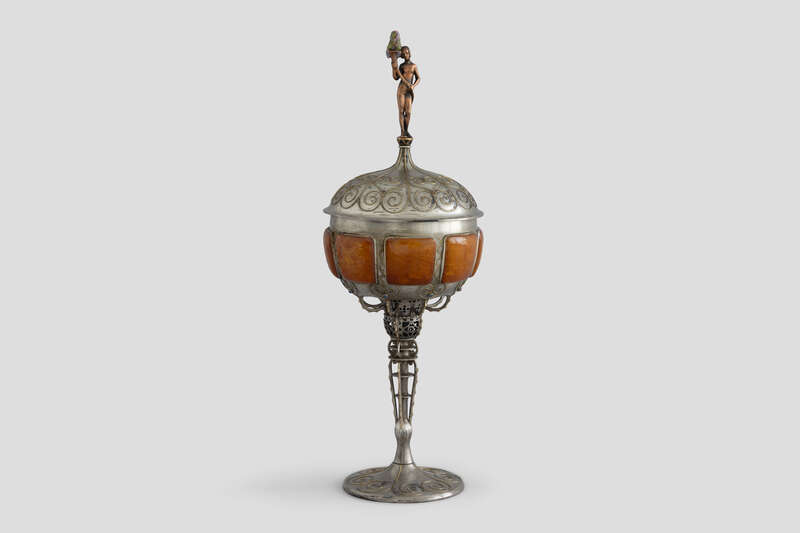
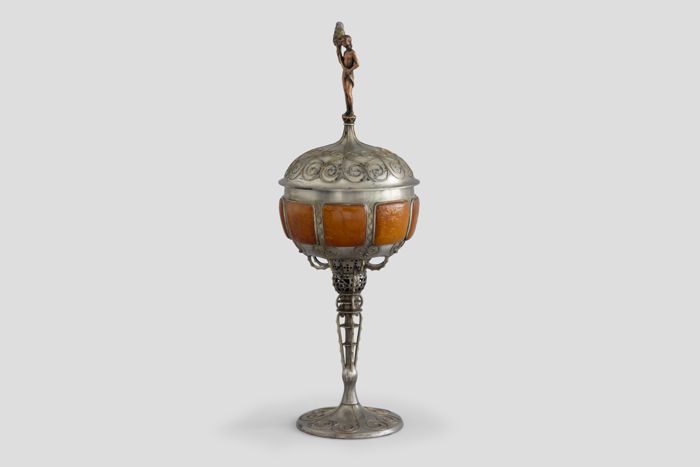
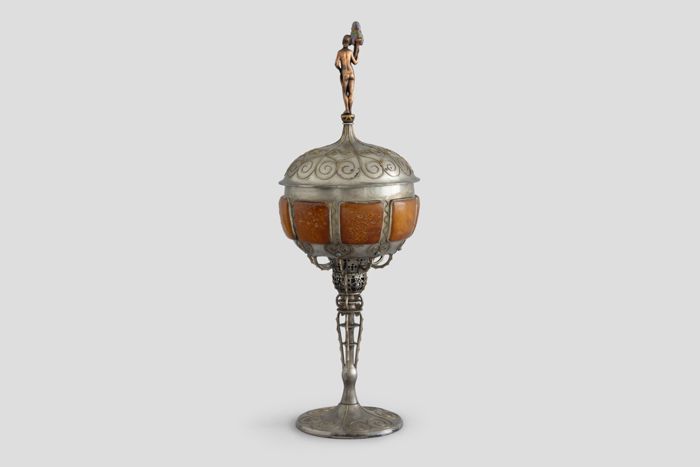
Covered goblet with copper crown figure holding an enameled grape
Ernst Riegel
ca. 1910
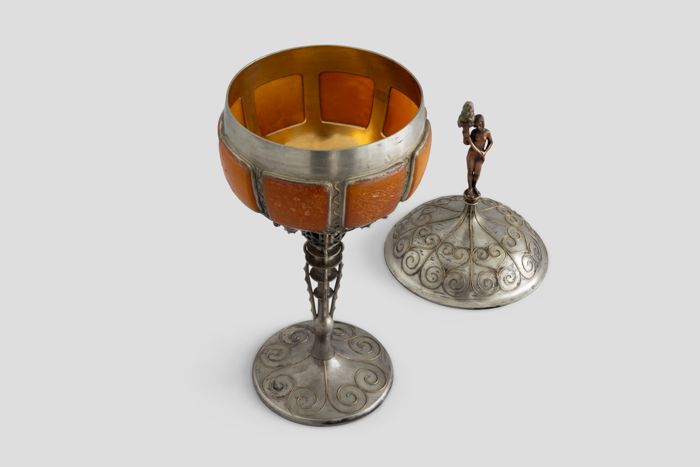
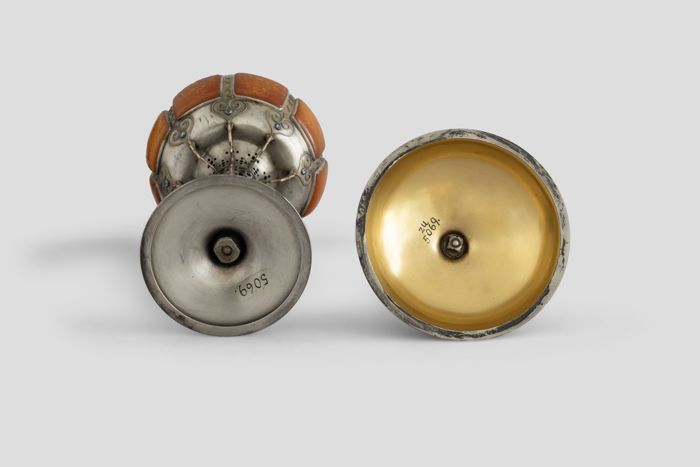
It is unclear whether this ornately designed covered goblet was ever used as a functional object. The decorative vessel is mainly made of silver. The foot, bowl (cup), and lid are decorated with heart-shaped spirals (volutes) made of gold wire. The bowl rests on a multipart shaft (baluster). Eight almost square amber plates are set into the wall, between which filigree bands wind their way along vertical bars. These end in the lower part of the bowl in hearts, each of which is set with a sapphire. The domed lid is crowned by a naked female figure holding up a cornucopia full of green-blue enameled grapes.
Riegel began an apprenticeship as a metal engraver in 1887 and studied under Fritz von Miller (18400–1921) at the Royal School of Arts and Crafts in Munich from 1890. He worked in Miller’s workshop from 1895. There he made his mark with the design of liturgical objects, goblets (cf. inv. no. 5069), medals, and bowls (cf. inv. no. St.248). From 1906 he was a member of the Darmstadt artists’ colony. In 1912, the School of Arts and Crafts in Cologne finally appointed him professor of goldsmithing. In 1933, the National Socialists removed him from his post and defamed him as an artist.
Title
Covered goblet with copper crown figure holding an enameled grape
Involved in the execution
Ernst Riegel (Artist) GND
Date
ca. 1910 (Production)
Geographical reference
Place of production: Darmstadt
Material / Technique
Silver, partially gold-plated, embossed, sawn; gold wire; amber; sapphires.
Copper crown figure with enameled grape.
Dimensions
Overall:
25,5 × 9,3 × 9,3 cm
Collection
Inventory number
5069
Creditline
Museum Angewandte Kunst, Frankfurt am Main
Accession
Purchase; 30.06.1910; Prof. Ernst Riegel, Darmstadt
- Key: 7e6c599d-ca2d-449b-970e-be9bf95fe3d5
- Module_ref: collection
- Create_date: 2008-12-15T23:00:00Z
- Change_date: 2026-06-25T14:08:54Z
- Sync_date: 2026-10-18T20:48:03Z
- Container_S: Jugendstil und Moderne
- InventoryNumber_S: 5069
- InventoryNumber_S_sort: 5069
- SimpleSearch: 5069,ca. 1910,Silver, partially gold-plated, embossed, sawn; gold wire; amber; sapphires.<br class="linefeed" />Copper crown figure with enameled grape.,Prof. Ernst Riegel, Darmstadt,Ernst,Riegel,Deckelpokal mit Bekrönungsfigur aus Kupfer und emaillierter Traube,Covered goblet with copper crown figure holding an enameled grape,Europe/Germany/Hesse/Darmstadt,Europe;;Germany;;Hesse;;Darmstadt,Silver,Gold,Brass,Amber,Gemstone,Enamel,Chasing,Riegel,Ernst,Riegel Ernst,Münnerstadt,Köln,It is unclear whether this ornately designed covered goblet was ever used as a functional object. The decorative vessel is mainly made of silver. The foot, bowl (cup), and lid are decorated with heart-shaped spirals (volutes) made of gold wire. The bowl rests on a multipart shaft (baluster). Eight almost square amber plates are set into the wall, between which filigree bands wind their way along vertical bars. These end in the lower part of the bowl in hearts, each of which is set with a sapphire. The domed lid is crowned by a naked female figure holding up a cornucopia full of green-blue enameled grapes.<br class="linefeed" /><br class="linefeed" />Riegel began an apprenticeship as a metal engraver in 1887 and studied under Fritz von Miller (18400–1921) at the Royal School of Arts and Crafts in Munich from 1890. He worked in Miller’s workshop from 1895. There he made his mark with the design of liturgical objects, goblets (cf. inv. no. 5069), medals, and bowls (cf. inv. no. St.248). From 1906 he was a member of the Darmstadt artists’ colony. In 1912, the School of Arts and Crafts in Cologne finally appointed him professor of goldsmithing. In 1933, the National Socialists removed him from his post and defamed him as an artist.
- SimpleSearch2: 5069,ca. 1910,Silver, partially gold-plated, embossed, sawn; gold wire; amber; sapphires.<br class="linefeed" />Copper crown figure with enameled grape.,Prof. Ernst Riegel, Darmstadt,Ernst,Riegel,Deckelpokal mit Bekrönungsfigur aus Kupfer und emaillierter Traube,Covered goblet with copper crown figure holding an enameled grape,Europe/Germany/Hesse/Darmstadt,Europe;;Germany;;Hesse;;Darmstadt,Silver,Gold,Brass,Amber,Gemstone,Enamel,Chasing,Riegel,Ernst,Riegel Ernst,Münnerstadt,Köln,It is unclear whether this ornately designed covered goblet was ever used as a functional object. The decorative vessel is mainly made of silver. The foot, bowl (cup), and lid are decorated with heart-shaped spirals (volutes) made of gold wire. The bowl rests on a multipart shaft (baluster). Eight almost square amber plates are set into the wall, between which filigree bands wind their way along vertical bars. These end in the lower part of the bowl in hearts, each of which is set with a sapphire. The domed lid is crowned by a naked female figure holding up a cornucopia full of green-blue enameled grapes.<br class="linefeed" /><br class="linefeed" />Riegel began an apprenticeship as a metal engraver in 1887 and studied under Fritz von Miller (18400–1921) at the Royal School of Arts and Crafts in Munich from 1890. He worked in Miller’s workshop from 1895. There he made his mark with the design of liturgical objects, goblets (cf. inv. no. 5069), medals, and bowls (cf. inv. no. St.248). From 1906 he was a member of the Darmstadt artists’ colony. In 1912, the School of Arts and Crafts in Cologne finally appointed him professor of goldsmithing. In 1933, the National Socialists removed him from his post and defamed him as an artist.
- InventoryNumberSearch_S: 5069
- IvNO_S: 5069
- AcquisitionDate_S: 30.06.1910
- MainTitle_S: Covered goblet with copper crown figure holding an enameled grape
- MainTitle_S_sort: Covered goblet with copper crown figure holding an enameled grape
- DatingType_S: Herstellung | Production
- Dating_S: ca. 1910
- Dating_S2: ca. 1910
- YearFrom_I: 1900
- YearTo_I: 1910
- DatingComment_S: Primärdatierung (englisch)
- Creditline_S: Museum Angewandte Kunst, Frankfurt am Main
- Systematic_S: Applied Arts in Europe
- Systematic_multi_facet: Applied Arts in Europe
- Systematic_multi_facet_filter: Applied Arts in Europe
- MaterialTechnique_S: Silver, partially gold-plated, embossed, sawn; gold wire; amber; sapphires.<br class="linefeed" />Copper crown figure with enameled grape.
- AcquisitionType_S: Purchase
- AcquisitionFrom_S: Prof. Ernst Riegel, Darmstadt
- Materials_multi_facet: Silver;;Gold;;Brass;;Amber;;Gemstone;;Enamel
- Materials_multi_facet_filter: Silver;;Gold;;Brass;;Amber;;Gemstone;;Enamel
- Techniques_multi_facet: Chasing
- Techniques_multi_facet_filter: Chasing
- Subjects_FirstName_multi_facet: Ernst
- Subjects_FirstName_multi_facet_filter: Ernst
- Subjects_Name_multi_facet: Riegel
- Subjects_Name_multi_facet_filter: Riegel
- Subjects_FullName_multi_facet: Ernst Riegel
- Subjects_FullName_multi_facet_filter: Ernst Riegel
- Subjects_NameSorted_multi_facet: Riegel, Ernst
- Subjects_NameSorted_multi_facet_filter: Riegel, Ernst
- lists_s: ObjectNames,Titles,GeographicReferences,Materials,Techniques,Datings,Subjects,Texts,Dimensions,WebLinks,Media
- list_ObjectNames_I: 0
- list_Titles_I: 2
- Titles_Type_0_S: Titel
- Titles_Text_0_S: Deckelpokal mit Bekrönungsfigur aus Kupfer und emaillierter Traube
- Titles_Text_S_sort: Deckelpokal mit Bekrönungsfigur aus Kupfer und emaillierter Traube
- TitleSearch: Deckelpokal mit Bekrönungsfigur aus Kupfer und emaillierter Traube,Covered goblet with copper crown figure holding an enameled grape
- Titles_Type_1_S: Titel (englisch)
- Titles_Text_1_S: Covered goblet with copper crown figure holding an enameled grape
- list_GeographicReferences_I: 1
- GeographicReferences_Type_0_S: Herstellungsort | Place of production
- GeographicReferences_Text_0_S: Europe/Germany/Hesse/Darmstadt
- GeographicReferences_Text_0_multi_facet: Europe;;Germany;;Hesse;;Darmstadt
- GeographicReferences_Text_0_multi_facet_filter: Europe;;Germany;;Hesse;;Darmstadt
- list_Materials_I: 6
- Materials_Type_0_S: Material
- Materials_Text_0_S: Silver
- Materials_Type_1_S: Material
- Materials_Text_1_S: Gold
- Materials_Type_2_S: Material
- Materials_Text_2_S: Brass
- Materials_Type_3_S: Material
- Materials_Text_3_S: Amber
- Materials_Type_4_S: Material
- Materials_Text_4_S: Gemstone
- Materials_Type_5_S: Material
- Materials_Text_5_S: Enamel
- list_Techniques_I: 2
- Techniques_Type_0_S: Technik
- Techniques_Text_0_S: Chasing
- Techniques_Type_1_S: Technik
- list_Datings_I: 0
- list_Subjects_I: 1
- Subjects_Role_0_S: Artist
- Subjects_Key_0_S: 873c139d-91d6-4868-8e73-88badafdfa77
- Subjects_Type_0_S: Person
- Subjects_Name_0_S: Riegel
- Subjects_FirstName_0_S: Ernst
- Subjects_SortedName_0_S: Riegel Ernst
- Subjects_S_sort: Riegel Ernst
- Subjects_Dating_0_S: 1871 - 1939
- Subjects_PlaceOfBirth_0_S: Münnerstadt
- Subjects_PlaceOfDeath_0_S: Köln
- Subjects_DayOfBirth_0_S: 12.09.1871
- Subjects_DayOfDeath_0_S: 14.02.1939
- Subjects_UriGnd_0_S: http://d-nb.info/gnd/119493012
- list_Texts_I: 1
- Texts_Type_0_S: Web (englisch)
- Texts_Language_0_S: EN
- Texts_LongText_0_S: It is unclear whether this ornately designed covered goblet was ever used as a functional object. The decorative vessel is mainly made of silver. The foot, bowl (cup), and lid are decorated with heart-shaped spirals (volutes) made of gold wire. The bowl rests on a multipart shaft (baluster). Eight almost square amber plates are set into the wall, between which filigree bands wind their way along vertical bars. These end in the lower part of the bowl in hearts, each of which is set with a sapphire. The domed lid is crowned by a naked female figure holding up a cornucopia full of green-blue enameled grapes.<br class="linefeed" /><br class="linefeed" />Riegel began an apprenticeship as a metal engraver in 1887 and studied under Fritz von Miller (18400–1921) at the Royal School of Arts and Crafts in Munich from 1890. He worked in Miller’s workshop from 1895. There he made his mark with the design of liturgical objects, goblets (cf. inv. no. 5069), medals, and bowls (cf. inv. no. St.248). From 1906 he was a member of the Darmstadt artists’ colony. In 1912, the School of Arts and Crafts in Cologne finally appointed him professor of goldsmithing. In 1933, the National Socialists removed him from his post and defamed him as an artist.
- list_Dimensions_I: 1
- Dimensions_Type_0_S: Objektmaß | Overall
- Dimensions_Dimension_0_S: 25,5 x 9,3 x 9,3 cm
- list_WebLinks_I: 0
- list_Media_I: 5
- Media_Key_0_s: 22b48ac9-8bd2-46f2-9ed9-75b76b895c3d
- Media_Type_0_S: Bild
- Media_Rightsholder_0_S: Museum Angewandte Kunst
- Media_Credits_0_S: Foto: Franziska Krieck © Museum Angewandte Kunst
- Media_Comments_0_S: CC BY-NC-SA 4.0
- Media_Key_1_s: 44cbff3e-294d-427e-96f5-48f84d1cad35
- Media_Type_1_S: Bild
- Media_Rightsholder_1_S: Museum Angewandte Kunst
- Media_Credits_1_S: Foto: Franziska Krieck © Museum Angewandte Kunst
- Media_Comments_1_S: CC BY-NC-SA 4.0
- Media_Key_2_s: 6fef731c-93c7-419c-b290-7b4e8ca705ea
- Media_Type_2_S: Bild
- Media_Rightsholder_2_S: Museum Angewandte Kunst
- Media_Credits_2_S: Foto: Franziska Krieck © Museum Angewandte Kunst
- Media_Comments_2_S: CC BY-NC-SA 4.0
- Media_Key_3_s: 3c5d3ab6-9bc9-489b-bf49-36b7fa67c416
- Media_Type_3_S: Bild
- Media_Rightsholder_3_S: Museum Angewandte Kunst
- Media_Credits_3_S: Foto: Franziska Krieck © Museum Angewandte Kunst
- Media_Key_4_s: d6d8dc36-ce3c-4cbd-ace9-22db8389468a
- Media_Type_4_S: Bild
- Media_Rightsholder_4_S: Museum Angewandte Kunst
- Media_Credits_4_S: Foto: Franziska Krieck © Museum Angewandte Kunst
- Media_Comments_4_S: CC BY-NC-SA 4.0
- _version_: 1879422784045580300
- lists: [object Object]

