
Home > Advanced search > Objects > Communion flagon
Communion flagon
Ernst Riegel
ca. 1910
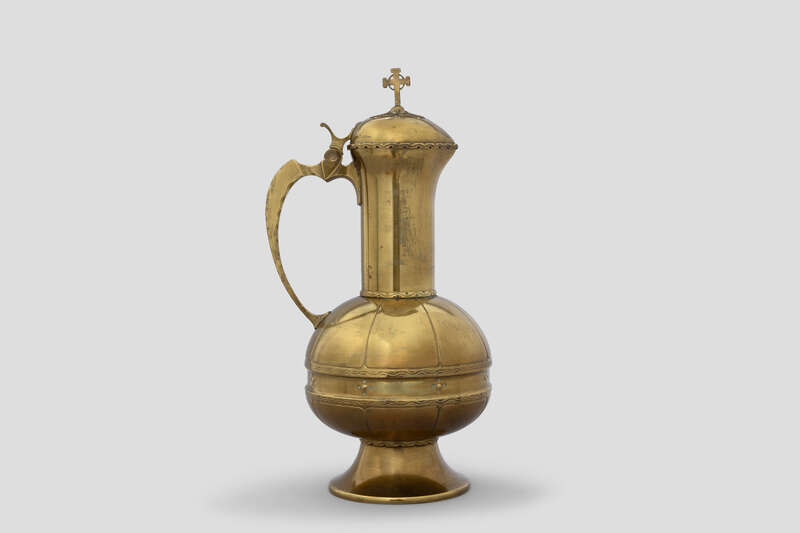
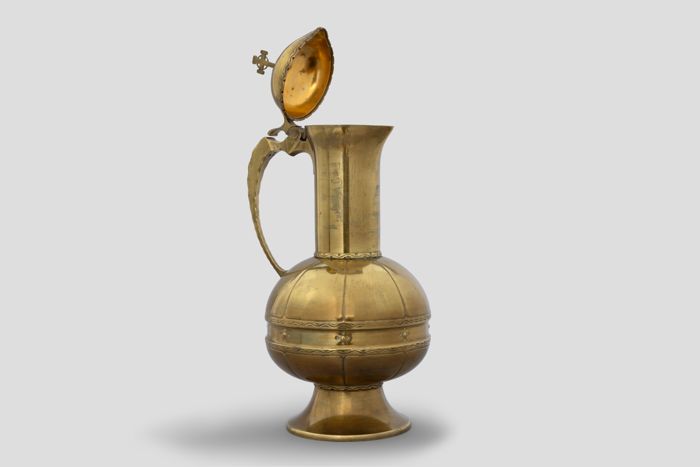
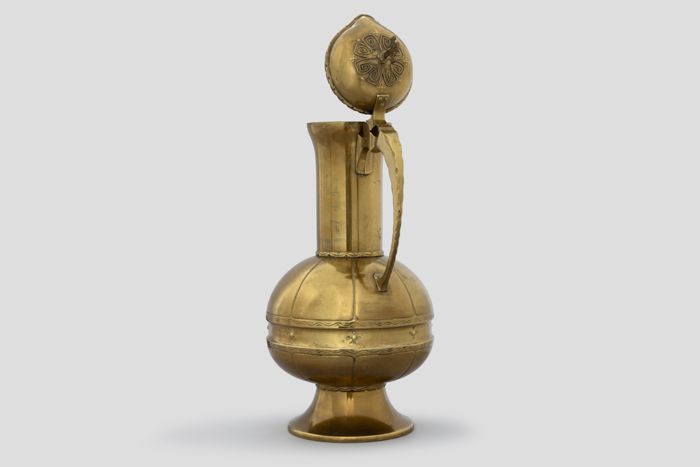
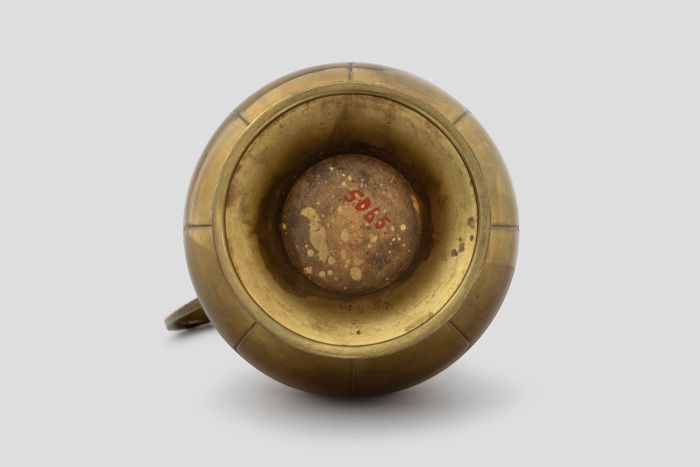
Wine is poured from pitchers like this one during the celebration of communion in Christian church services. Ernst Riegel designed the flagon, which is made of brass and gilded on the inside. A horizontal decorative strip, slightly recessed, and edged by an undulating band, encircles the spherical body, which rests on a foot. It divides the vessel optically into two halves, the surfaces of which are each divided into eight sections. The long, cylindrical neck ends in an elongated spout on one side. Opposite is an ear-shaped handle with jagged edges that tapers toward the bottom. A domed lid with thumb rest completes the flagon. A cross is perched on the lid, resting on a six-petalled rosette.
Riegel designed the flagon in 1907 or 1908 as part of his efforts to produce simply designed liturgical objects for less affluent Protestant congregations. According to a note by Riegel, the flagon “made for Waldülfersheim was returned by the pastor. The communion flagon was then purchased by the Arts and Crafts museum in Frankfurt a.M. [now the Museum Angewandte Kunst].” It was therefore presumably never or only rarely used in a church service.
Riegel began an apprenticeship as a metal engraver in 1887 and studied under Fritz von Miller (18400–1921) at the Royal School of Arts and Crafts in Munich from 1890. He worked in Miller’s workshop from 1895. There he made his mark with the design of liturgical objects, goblets (cf. inv. no. 5069), medals, and bowls (cf. inv. no. St.248). From 1906 he was a member of the Darmstadt artists’ colony. In 1912, the School of Arts and Crafts in Cologne finally appointed him professor of goldsmithing. In 1933, the National Socialists removed him from his post and defamed him as an artist.
Title
Communion flagon
Involved in the execution
Ernst Riegel (Artist) GND
Date
ca. 1910 (Production)
Geographical reference
Place of production: Darmstadt
Material / Technique
Brass, cast, chased; filigree
Dimensions
Height:
32 cm
Object type
Collection
Inventory number
5065
Creditline
Museum Angewandte Kunst, Frankfurt am Main
Accession
Purchase; 28.04.1910; Prof. Ernst Riegel, Darmstadt
- Key: 86e15850-f521-4ac8-9905-ce8d36a3cec1
- Module_ref: collection
- Create_date: 2009-11-16T23:00:00Z
- Change_date: 2026-06-25T09:13:06Z
- Sync_date: 2026-10-18T20:48:09Z
- Container_S: Jugendstil und Moderne
- InventoryNumber_S: 5065
- InventoryNumber_S_sort: 5065
- SimpleSearch: 5065,ca. 1910,Brass, cast, chased; filigree,Prof. Ernst Riegel, Darmstadt,Ernst,Riegel,Ewers,Abendmahlskanne,Communion flagon,Europe/Germany/Hesse/Darmstadt,Europe;;Germany;;Hesse;;Darmstadt,Brass,Casting,Chiseling,Riegel,Ernst,Riegel Ernst,Münnerstadt,Köln,Wine is poured from pitchers like this one during the celebration of communion in Christian church services. Ernst Riegel designed the flagon, which is made of brass and gilded on the inside. A horizontal decorative strip, slightly recessed, and edged by an undulating band, encircles the spherical body, which rests on a foot. It divides the vessel optically into two halves, the surfaces of which are each divided into eight sections. The long, cylindrical neck ends in an elongated spout on one side. Opposite is an ear-shaped handle with jagged edges that tapers toward the bottom. A domed lid with thumb rest completes the flagon. A cross is perched on the lid, resting on a six-petalled rosette.<br class="linefeed" /><br class="linefeed" />Riegel designed the flagon in 1907 or 1908 as part of his efforts to produce simply designed liturgical objects for less affluent Protestant congregations. According to a note by Riegel, the flagon “made for Waldülfersheim was returned by the pastor. The communion flagon was then purchased by the Arts and Crafts museum in Frankfurt a.M. [now the Museum Angewandte Kunst].” It was therefore presumably never or only rarely used in a church service.<br class="linefeed" /><br class="linefeed" />Riegel began an apprenticeship as a metal engraver in 1887 and studied under Fritz von Miller (18400–1921) at the Royal School of Arts and Crafts in Munich from 1890. He worked in Miller’s workshop from 1895. There he made his mark with the design of liturgical objects, goblets (cf. inv. no. 5069), medals, and bowls (cf. inv. no. St.248). From 1906 he was a member of the Darmstadt artists’ colony. In 1912, the School of Arts and Crafts in Cologne finally appointed him professor of goldsmithing. In 1933, the National Socialists removed him from his post and defamed him as an artist.,Frontale Ansicht einer Kanne aus Messing mit kugelförmigen Bauch, langem zylinderförmigen Hals und Klappdeckel, auf dem mittig ein Kreuz angebracht ist. Der Griff zeigt nach links.,Leicht schräge Ansicht der Kanne mit geöffnetem Deckel,Die Kanne von hinten, leicht seitlich gedreht. Der Deckel ist geöffnet.,Die Kanne liegend, sodass der Boden sichtbar wird.
- SimpleSearch2: 5065,ca. 1910,Brass, cast, chased; filigree,Prof. Ernst Riegel, Darmstadt,Ernst,Riegel,Ewers,Abendmahlskanne,Communion flagon,Europe/Germany/Hesse/Darmstadt,Europe;;Germany;;Hesse;;Darmstadt,Brass,Casting,Chiseling,Riegel,Ernst,Riegel Ernst,Münnerstadt,Köln,Wine is poured from pitchers like this one during the celebration of communion in Christian church services. Ernst Riegel designed the flagon, which is made of brass and gilded on the inside. A horizontal decorative strip, slightly recessed, and edged by an undulating band, encircles the spherical body, which rests on a foot. It divides the vessel optically into two halves, the surfaces of which are each divided into eight sections. The long, cylindrical neck ends in an elongated spout on one side. Opposite is an ear-shaped handle with jagged edges that tapers toward the bottom. A domed lid with thumb rest completes the flagon. A cross is perched on the lid, resting on a six-petalled rosette.<br class="linefeed" /><br class="linefeed" />Riegel designed the flagon in 1907 or 1908 as part of his efforts to produce simply designed liturgical objects for less affluent Protestant congregations. According to a note by Riegel, the flagon “made for Waldülfersheim was returned by the pastor. The communion flagon was then purchased by the Arts and Crafts museum in Frankfurt a.M. [now the Museum Angewandte Kunst].” It was therefore presumably never or only rarely used in a church service.<br class="linefeed" /><br class="linefeed" />Riegel began an apprenticeship as a metal engraver in 1887 and studied under Fritz von Miller (18400–1921) at the Royal School of Arts and Crafts in Munich from 1890. He worked in Miller’s workshop from 1895. There he made his mark with the design of liturgical objects, goblets (cf. inv. no. 5069), medals, and bowls (cf. inv. no. St.248). From 1906 he was a member of the Darmstadt artists’ colony. In 1912, the School of Arts and Crafts in Cologne finally appointed him professor of goldsmithing. In 1933, the National Socialists removed him from his post and defamed him as an artist.,Frontale Ansicht einer Kanne aus Messing mit kugelförmigen Bauch, langem zylinderförmigen Hals und Klappdeckel, auf dem mittig ein Kreuz angebracht ist. Der Griff zeigt nach links.,Leicht schräge Ansicht der Kanne mit geöffnetem Deckel,Die Kanne von hinten, leicht seitlich gedreht. Der Deckel ist geöffnet.,Die Kanne liegend, sodass der Boden sichtbar wird.
- InventoryNumberSearch_S: 5065
- IvNO_S: 5065
- AcquisitionDate_S: 28.04.1910
- MainTitle_S: Communion flagon
- MainTitle_S_sort: Communion flagon
- DatingType_S: Herstellung | Production
- Dating_S: ca. 1910
- Dating_S2: ca. 1910
- YearFrom_I: 1900
- YearTo_I: 1920
- DatingComment_S: Primärdatierung (englisch)
- Creditline_S: Museum Angewandte Kunst, Frankfurt am Main
- Systematic_S: Applied Arts in Europe
- Systematic_multi_facet: Applied Arts in Europe
- Systematic_multi_facet_filter: Applied Arts in Europe
- MaterialTechnique_S: Brass, cast, chased; filigree
- AcquisitionType_S: Purchase
- AcquisitionFrom_S: Prof. Ernst Riegel, Darmstadt
- Materials_multi_facet: Brass
- Materials_multi_facet_filter: Brass
- Techniques_multi_facet: Casting;;Chiseling
- Techniques_multi_facet_filter: Casting;;Chiseling
- Subjects_FirstName_multi_facet: Ernst
- Subjects_FirstName_multi_facet_filter: Ernst
- Subjects_Name_multi_facet: Riegel
- Subjects_Name_multi_facet_filter: Riegel
- Subjects_FullName_multi_facet: Ernst Riegel
- Subjects_FullName_multi_facet_filter: Ernst Riegel
- Subjects_NameSorted_multi_facet: Riegel, Ernst
- Subjects_NameSorted_multi_facet_filter: Riegel, Ernst
- lists_s: ObjectNames,Titles,GeographicReferences,Materials,Techniques,Datings,Subjects,Texts,Dimensions,WebLinks,Media
- list_ObjectNames_I: 1
- ObjectNames_Type_0_S: Obj.bez.
- ObjectNames_Text_0_S: Ewers
- list_Titles_I: 2
- Titles_Type_0_S: Titel
- Titles_Text_0_S: Abendmahlskanne
- Titles_Text_S_sort: Abendmahlskanne
- TitleSearch: Abendmahlskanne,Communion flagon
- Titles_Type_1_S: Titel (englisch)
- Titles_Text_1_S: Communion flagon
- list_GeographicReferences_I: 1
- GeographicReferences_Type_0_S: Herstellungsort | Place of production
- GeographicReferences_Text_0_S: Europe/Germany/Hesse/Darmstadt
- GeographicReferences_Text_0_multi_facet: Europe;;Germany;;Hesse;;Darmstadt
- GeographicReferences_Text_0_multi_facet_filter: Europe;;Germany;;Hesse;;Darmstadt
- list_Materials_I: 1
- Materials_Type_0_S: Material
- Materials_Text_0_S: Brass
- list_Techniques_I: 2
- Techniques_Type_0_S: Technik
- Techniques_Text_0_S: Casting
- Techniques_Type_1_S: Technik
- Techniques_Text_1_S: Chiseling
- list_Datings_I: 0
- list_Subjects_I: 1
- Subjects_Role_0_S: Artist
- Subjects_Key_0_S: 873c139d-91d6-4868-8e73-88badafdfa77
- Subjects_Type_0_S: Person
- Subjects_Name_0_S: Riegel
- Subjects_FirstName_0_S: Ernst
- Subjects_SortedName_0_S: Riegel Ernst
- Subjects_S_sort: Riegel Ernst
- Subjects_Dating_0_S: 1871 - 1939
- Subjects_PlaceOfBirth_0_S: Münnerstadt
- Subjects_PlaceOfDeath_0_S: Köln
- Subjects_DayOfBirth_0_S: 12.09.1871
- Subjects_DayOfDeath_0_S: 14.02.1939
- Subjects_UriGnd_0_S: http://d-nb.info/gnd/119493012
- list_Texts_I: 1
- Texts_Type_0_S: Web (englisch)
- Texts_Language_0_S: EN
- Texts_LongText_0_S: Wine is poured from pitchers like this one during the celebration of communion in Christian church services. Ernst Riegel designed the flagon, which is made of brass and gilded on the inside. A horizontal decorative strip, slightly recessed, and edged by an undulating band, encircles the spherical body, which rests on a foot. It divides the vessel optically into two halves, the surfaces of which are each divided into eight sections. The long, cylindrical neck ends in an elongated spout on one side. Opposite is an ear-shaped handle with jagged edges that tapers toward the bottom. A domed lid with thumb rest completes the flagon. A cross is perched on the lid, resting on a six-petalled rosette.<br class="linefeed" /><br class="linefeed" />Riegel designed the flagon in 1907 or 1908 as part of his efforts to produce simply designed liturgical objects for less affluent Protestant congregations. According to a note by Riegel, the flagon “made for Waldülfersheim was returned by the pastor. The communion flagon was then purchased by the Arts and Crafts museum in Frankfurt a.M. [now the Museum Angewandte Kunst].” It was therefore presumably never or only rarely used in a church service.<br class="linefeed" /><br class="linefeed" />Riegel began an apprenticeship as a metal engraver in 1887 and studied under Fritz von Miller (18400–1921) at the Royal School of Arts and Crafts in Munich from 1890. He worked in Miller’s workshop from 1895. There he made his mark with the design of liturgical objects, goblets (cf. inv. no. 5069), medals, and bowls (cf. inv. no. St.248). From 1906 he was a member of the Darmstadt artists’ colony. In 1912, the School of Arts and Crafts in Cologne finally appointed him professor of goldsmithing. In 1933, the National Socialists removed him from his post and defamed him as an artist.
- list_Dimensions_I: 1
- Dimensions_Type_0_S: Höhe | Height
- Dimensions_Dimension_0_S: 32 cm
- list_WebLinks_I: 0
- list_Media_I: 4
- Media_Key_0_s: 0fa338f7-1ca2-42f0-ade6-93903be41055
- Media_Type_0_S: Bild
- Media_AltText_0_S: Frontale Ansicht einer Kanne aus Messing mit kugelförmigen Bauch, langem zylinderförmigen Hals und Klappdeckel, auf dem mittig ein Kreuz angebracht ist. Der Griff zeigt nach links.
- Media_Rightsholder_0_S: Museum Angewandte Kunst
- Media_Credits_0_S: Foto: Franziska Krieck © Museum Angewandte Kunst
- Media_Comments_0_S: CC BY-NC-SA 4.0
- Media_Key_1_s: 485e18c6-4cbb-41f1-a6d7-f6c14cd64728
- Media_Type_1_S: Bild
- Media_AltText_1_S: Leicht schräge Ansicht der Kanne mit geöffnetem Deckel
- Media_Rightsholder_1_S: Museum Angewandte Kunst
- Media_Credits_1_S: Foto: Franziska Krieck © Museum Angewandte Kunst
- Media_Comments_1_S: CC BY-NC-SA 4.0
- Media_Key_2_s: 0d9896d8-c2af-4ea2-828c-feb36781beac
- Media_Type_2_S: Bild
- Media_AltText_2_S: Die Kanne von hinten, leicht seitlich gedreht. Der Deckel ist geöffnet.
- Media_Rightsholder_2_S: Museum Angewandte Kunst
- Media_Credits_2_S: Foto: Franziska Krieck © Museum Angewandte Kunst
- Media_Comments_2_S: CC BY-NC-SA 4.0
- Media_Key_3_s: d366f5c0-de7f-4937-a027-ac97fba329af
- Media_Type_3_S: Bild
- Media_AltText_3_S: Die Kanne liegend, sodass der Boden sichtbar wird.
- Media_Rightsholder_3_S: Museum Angewandte Kunst
- Media_Credits_3_S: Foto: Franziska Krieck © Museum Angewandte Kunst
- Media_Comments_3_S: CC BY-NC-SA 4.0
- _version_: 1879422795486593000
- lists: [object Object]

