
Home > Advanced search > Objects > Pendant light
Pendant light
Adolf Meyer; Zeiss Ikon AG
1929
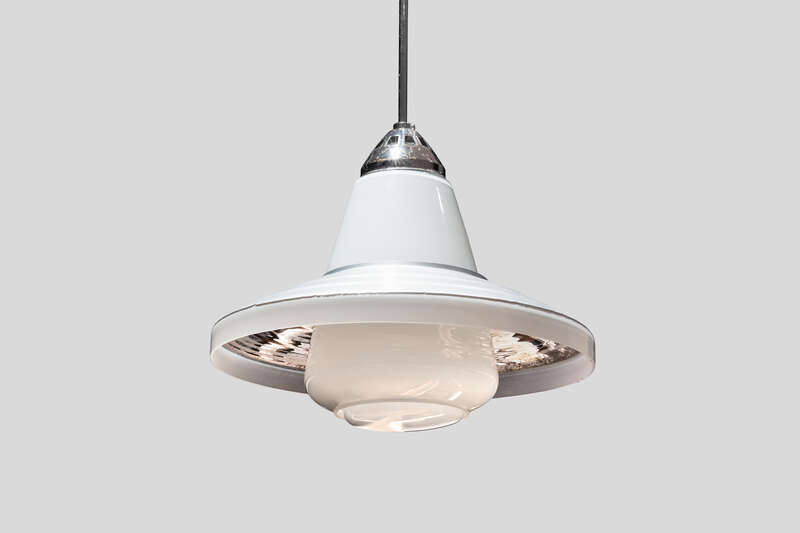
Adolf Meyer (1881–1929) worked only briefly as an architect and head of the Construction Consulting Department at the Frankfurt Building Authority, but his time there was very productive. In addition to numerous buildings, he also designed everyday objects such as furniture, fire alarms, and this hanging lamp. He arranged the different opaque and translucent properties of industrial glass in such a way that the light was optimally guided and diffused. The Berlin factory Zeiss Ikon produced the lamp in two sizes, of which the museum owns the smaller one.
In 1926, Meyer moved to Frankfurt from Weimar, where, as master craftsman at the Bauhaus and Walter Gropius’s right-hand man, he had taught technical drawing and construction technology. In Frankfurt, he designed several industrial buildings, such as the Rebstockgelände radio station, the coking plant and the Ost gasworks, as well as the power station. He also planned structures to regulate the Nidda River: four weirs, new bridges, and the nature swimming pool in Brentanopark. The kindergarten in Sommerhoff Park and the Westend youth center were also based on his designs. After his sudden death in 1929 in a swimming accident on Borkum, the magazine Das Neue Frankfurt dedicated a special issue and an exhibition to him. After that, however, Adolf Meyer fell into oblivion.
Title
Pendant light
Involved in the execution
Adolf Meyer (Design) GND
Zeiss Ikon AG (Production) GND
Date
1929 (Designing)
Geographical reference
Place of production: Berlin
Material / Technique
Metal, chrome-plated; glass, powder-coated; industrially manufactured
Dimensions
Overall:
90 × 37 × 37 cm
Object type
Collection
Inventory number
19350
Creditline
Museum Angewandte Kunst, Frankfurt am Main
Included in these topics
- Key: d8180f9a-b15a-4723-9232-14430fb5e518
- Module_ref: collection
- Create_date: 2023-08-28T07:13:59Z
- Change_date: 2026-01-27T09:37:28Z
- Sync_date: 2026-10-04T20:48:13Z
- Container_S: Design
- InventoryNumber_S: 19350
- InventoryNumber_S_sort: 19350
- SimpleSearch: 19350,1929,Metal, chrome-plated; glass, powder-coated; industrially manufactured,New Frankfurt, Industrial design, White,Adolf,Meyer;;Zeiss Ikon AG,Hanging lamps,Hängeleuchte,Pendant light,Europe/Germany/Berlin,Europe;;Germany;;Berlin,Metal,Glass,Industrial production,Meyer,Adolf,Meyer, Adolf,Mechernich,Baltrum,Zeiss Ikon AG,Zeiss Ikon AG,Stuttgart,Adolf Meyer (1881–1929) worked only briefly as an architect and head of the Construction Consulting Department at the Frankfurt Building Authority, but his time there was very productive. In addition to numerous buildings, he also designed everyday objects such as furniture, fire alarms, and this hanging lamp. He arranged the different opaque and translucent properties of industrial glass in such a way that the light was optimally guided and diffused. The Berlin factory Zeiss Ikon produced the lamp in two sizes, of which the museum owns the smaller one.<br class="linefeed" /><br class="linefeed" />In 1926, Meyer moved to Frankfurt from Weimar, where, as master craftsman at the Bauhaus and Walter Gropius’s right-hand man, he had taught technical drawing and construction technology. In Frankfurt, he designed several industrial buildings, such as the Rebstockgelände radio station, the coking plant and the Ost gasworks, as well as the power station. He also planned structures to regulate the Nidda River: four weirs, new bridges, and the nature swimming pool in Brentanopark. The kindergarten in Sommerhoff Park and the Westend youth center were also based on his designs. After his sudden death in 1929 in a swimming accident on Borkum, the magazine Das Neue Frankfurt dedicated a special issue and an exhibition to him. After that, however, Adolf Meyer fell into oblivion.,Frontale Ansicht einer weißen Hängelampe mit zweiteiligem Schirm: der innere konisch und aus pulverbeschichtetem Glas, der äußere ausladender mit einer innenseitigen Beschichtung aus Chrom
- SimpleSearch2: 19350,1929,Metal, chrome-plated; glass, powder-coated; industrially manufactured,New Frankfurt, Industrial design, White,Adolf,Meyer;;Zeiss Ikon AG,Hanging lamps,Hängeleuchte,Pendant light,Europe/Germany/Berlin,Europe;;Germany;;Berlin,Metal,Glass,Industrial production,Meyer,Adolf,Meyer, Adolf,Mechernich,Baltrum,Zeiss Ikon AG,Zeiss Ikon AG,Stuttgart,Adolf Meyer (1881–1929) worked only briefly as an architect and head of the Construction Consulting Department at the Frankfurt Building Authority, but his time there was very productive. In addition to numerous buildings, he also designed everyday objects such as furniture, fire alarms, and this hanging lamp. He arranged the different opaque and translucent properties of industrial glass in such a way that the light was optimally guided and diffused. The Berlin factory Zeiss Ikon produced the lamp in two sizes, of which the museum owns the smaller one.<br class="linefeed" /><br class="linefeed" />In 1926, Meyer moved to Frankfurt from Weimar, where, as master craftsman at the Bauhaus and Walter Gropius’s right-hand man, he had taught technical drawing and construction technology. In Frankfurt, he designed several industrial buildings, such as the Rebstockgelände radio station, the coking plant and the Ost gasworks, as well as the power station. He also planned structures to regulate the Nidda River: four weirs, new bridges, and the nature swimming pool in Brentanopark. The kindergarten in Sommerhoff Park and the Westend youth center were also based on his designs. After his sudden death in 1929 in a swimming accident on Borkum, the magazine Das Neue Frankfurt dedicated a special issue and an exhibition to him. After that, however, Adolf Meyer fell into oblivion.,Frontale Ansicht einer weißen Hängelampe mit zweiteiligem Schirm: der innere konisch und aus pulverbeschichtetem Glas, der äußere ausladender mit einer innenseitigen Beschichtung aus Chrom
- InventoryNumberSearch_S: 19350
- IvNO_S: 19350
- AcquisitionDate_S: 31.12.2023
- MainTitle_S: Pendant light
- MainTitle_S_sort: Pendant light
- DatingType_S: Entwurf | Designing
- Dating_S: 1929
- Dating_S2: 1929
- YearFrom_I: 1929
- YearTo_I: 1929
- Copyright_S: Urheberrechtsschutz - Rechteinhaber nicht auffindbar oder identifizierbar
- Creditline_S: Museum Angewandte Kunst, Frankfurt am Main
- Systematic_S: Design
- Systematic_multi_facet: Design
- Systematic_multi_facet_filter: Design
- MaterialTechnique_S: Metal, chrome-plated; glass, powder-coated; industrially manufactured
- Keywords_S: New Frankfurt, Industrial design, White
- Keywords_multi_facet: New Frankfurt;;Industrial design;;White
- Keywords_multi_facet_filter: New Frankfurt;;Industrial design;;White
- Materials_multi_facet: Metal;;Glass
- Materials_multi_facet_filter: Metal;;Glass
- Techniques_multi_facet: Industrial production
- Techniques_multi_facet_filter: Industrial production
- Subjects_FirstName_multi_facet: Adolf
- Subjects_FirstName_multi_facet_filter: Adolf
- Subjects_Name_multi_facet: Meyer;;Zeiss Ikon AG
- Subjects_Name_multi_facet_filter: Meyer;;Zeiss Ikon AG
- Subjects_FullName_multi_facet: Adolf Meyer;;Zeiss Ikon AG
- Subjects_FullName_multi_facet_filter: Adolf Meyer;;Zeiss Ikon AG
- Subjects_NameSorted_multi_facet: Meyer, Adolf;;Zeiss Ikon AG
- Subjects_NameSorted_multi_facet_filter: Meyer, Adolf;;Zeiss Ikon AG
- lists_s: ObjectNames,Titles,GeographicReferences,Materials,Techniques,Datings,Subjects,Texts,Dimensions,WebLinks,Media
- list_ObjectNames_I: 1
- ObjectNames_Type_0_S: Obj.bez.
- ObjectNames_Text_0_S: Hanging lamps
- list_Titles_I: 2
- Titles_Type_0_S: Titel
- Titles_Text_0_S: Hängeleuchte
- Titles_Text_S_sort: Hängeleuchte
- TitleSearch: Hängeleuchte,Pendant light
- Titles_Type_1_S: Titel (englisch)
- Titles_Text_1_S: Pendant light
- list_GeographicReferences_I: 1
- GeographicReferences_Type_0_S: Herstellungsort | Place of production
- GeographicReferences_Text_0_S: Europe/Germany/Berlin
- GeographicReferences_Text_0_multi_facet: Europe;;Germany;;Berlin
- GeographicReferences_Text_0_multi_facet_filter: Europe;;Germany;;Berlin
- list_Materials_I: 2
- Materials_Type_0_S: Material
- Materials_Text_0_S: Metal
- Materials_Type_1_S: Material
- Materials_Text_1_S: Glass
- list_Techniques_I: 1
- Techniques_Type_0_S: Technik
- Techniques_Text_0_S: Industrial production
- list_Datings_I: 0
- list_Subjects_I: 2
- Subjects_Role_0_S: Design
- Subjects_Key_0_S: e80f6dd5-50d5-480f-b1e4-42e36d13e1d8
- Subjects_Type_0_S: Person
- Subjects_Name_0_S: Meyer
- Subjects_FirstName_0_S: Adolf
- Subjects_SortedName_0_S: Meyer, Adolf
- Subjects_S_sort: Meyer, Adolf
- Subjects_Dating_0_S: 1881-1929
- Subjects_PlaceOfBirth_0_S: Mechernich
- Subjects_PlaceOfDeath_0_S: Baltrum
- Subjects_DayOfBirth_0_S: 17.06.1881
- Subjects_DayOfDeath_0_S: 14.07.1929
- Subjects_UriGnd_0_S: http://d-nb.info/gnd/119315033
- Subjects_Role_1_S: Production
- Subjects_Key_1_S: 25460030-591d-48f6-a713-7633dd9aadf9
- Subjects_Type_1_S: Körperschaft
- Subjects_Name_1_S: Zeiss Ikon AG
- Subjects_SortedName_1_S: Zeiss Ikon AG
- Subjects_Dating_1_S: 1926-1989
- Subjects_PlaceOfBirth_1_S: Stuttgart
- Subjects_UriGnd_1_S: http://d-nb.info/gnd/55009-7
- list_Texts_I: 1
- Texts_Type_0_S: Web (englisch)
- Texts_Language_0_S: EN
- Texts_LongText_0_S: Adolf Meyer (1881–1929) worked only briefly as an architect and head of the Construction Consulting Department at the Frankfurt Building Authority, but his time there was very productive. In addition to numerous buildings, he also designed everyday objects such as furniture, fire alarms, and this hanging lamp. He arranged the different opaque and translucent properties of industrial glass in such a way that the light was optimally guided and diffused. The Berlin factory Zeiss Ikon produced the lamp in two sizes, of which the museum owns the smaller one.<br class="linefeed" /><br class="linefeed" />In 1926, Meyer moved to Frankfurt from Weimar, where, as master craftsman at the Bauhaus and Walter Gropius’s right-hand man, he had taught technical drawing and construction technology. In Frankfurt, he designed several industrial buildings, such as the Rebstockgelände radio station, the coking plant and the Ost gasworks, as well as the power station. He also planned structures to regulate the Nidda River: four weirs, new bridges, and the nature swimming pool in Brentanopark. The kindergarten in Sommerhoff Park and the Westend youth center were also based on his designs. After his sudden death in 1929 in a swimming accident on Borkum, the magazine Das Neue Frankfurt dedicated a special issue and an exhibition to him. After that, however, Adolf Meyer fell into oblivion.
- list_Dimensions_I: 1
- Dimensions_Type_0_S: Objektmaß | Overall
- Dimensions_Dimension_0_S: 90 x 37 x 37 cm
- list_WebLinks_I: 0
- list_Media_I: 1
- Media_Key_0_s: a66f41f9-9426-4d60-b6fb-882bac721bbe
- Media_Type_0_S: Bild
- Media_AltText_0_S: Frontale Ansicht einer weißen Hängelampe mit zweiteiligem Schirm: der innere konisch und aus pulverbeschichtetem Glas, der äußere ausladender mit einer innenseitigen Beschichtung aus Chrom
- Media_Rightsholder_0_S: Museum Angewandte Kunst
- Media_Credits_0_S: Foto: Günzel/Rademacher © Museum Angewandte Kunst
- _version_: 1878154434844819500
- lists: [object Object]

