
Home > Advanced search > Objects > Calendar for the year 1926
Calendar for the year 1926
D. Stempel AG; Rudolf Wolf; Friedrich Wilhelm Kleukens
1926
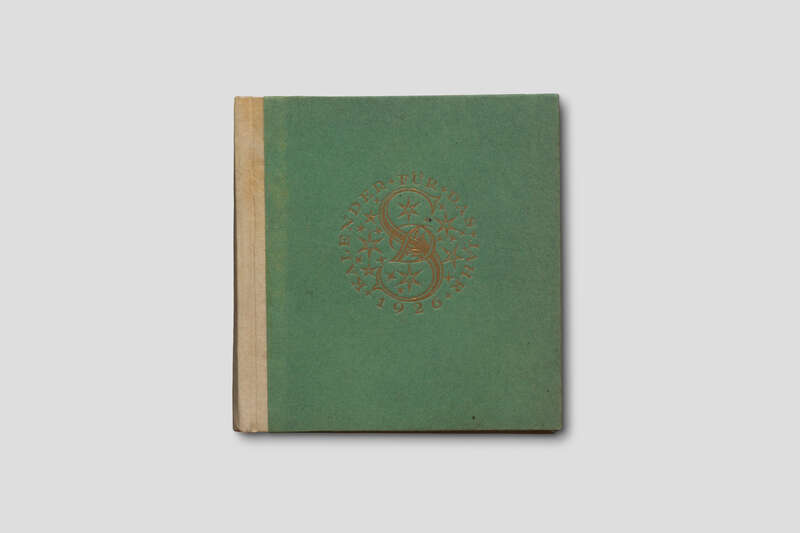
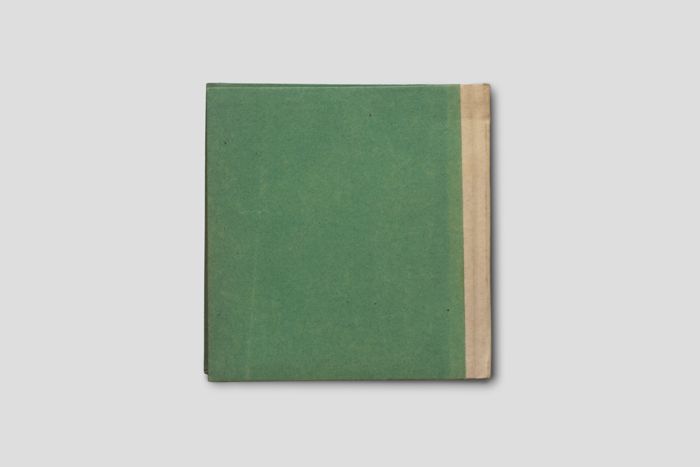
The booklet’s plain cover made of green and off-white paper recedes behind an elaborate gold embossing. An intertwined monogram consisting of the letters “D” and “S” is framed by stars in outline and enclosed by a circular text: “Calendar for the year 1926.” It was published by the Frankfurt type foundry D. Stempel. Calendars like this served as a calling card to showcase the quality of typographic and printmaking craftsmanship and to promote new typefaces.
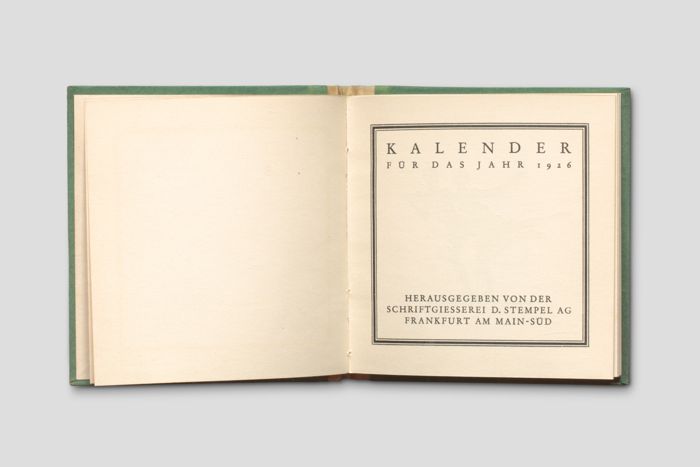
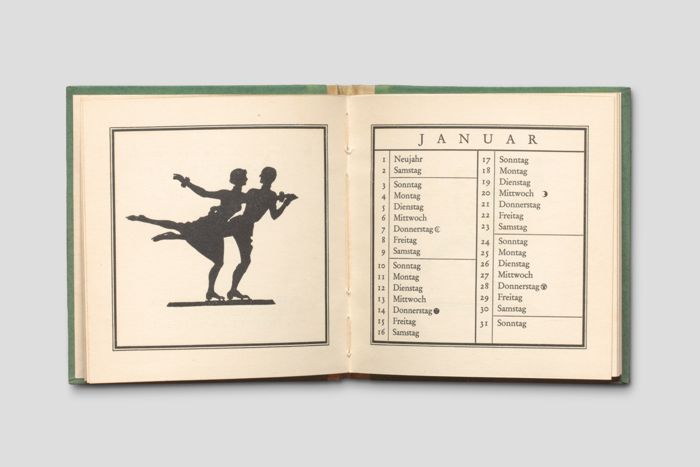
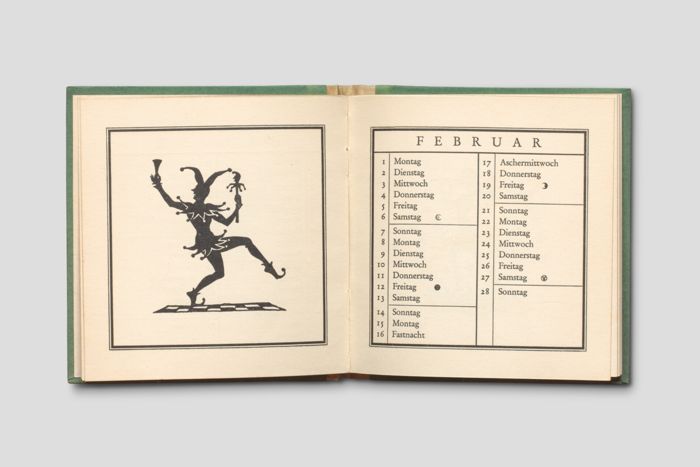
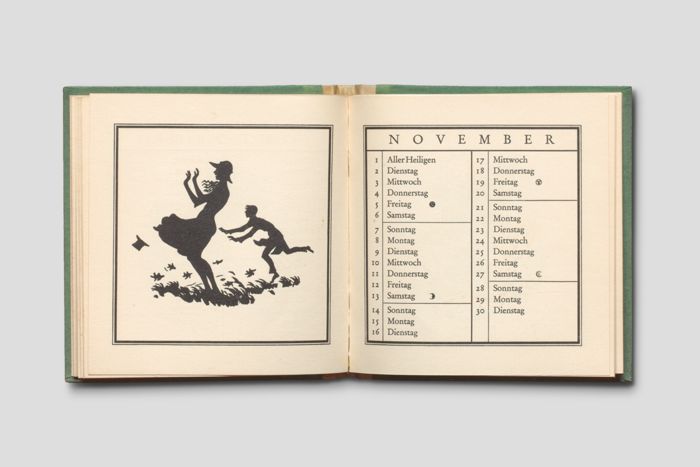
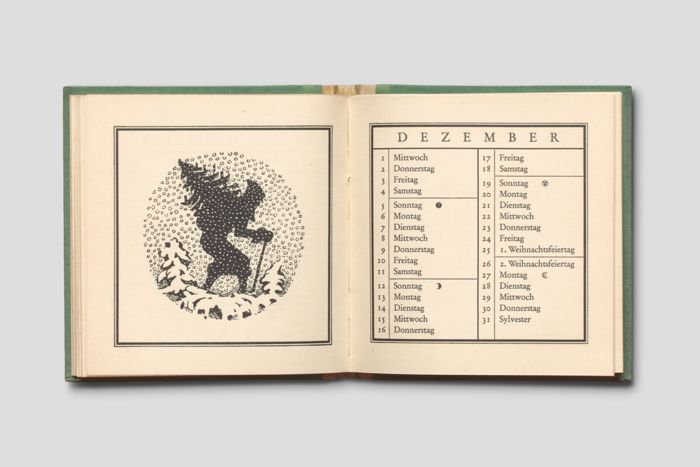
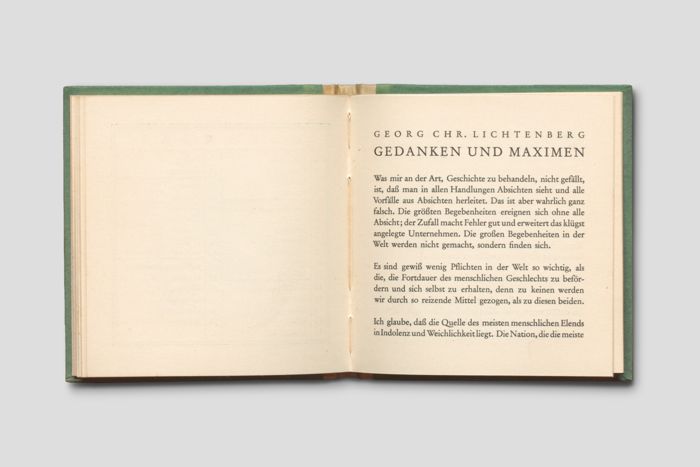
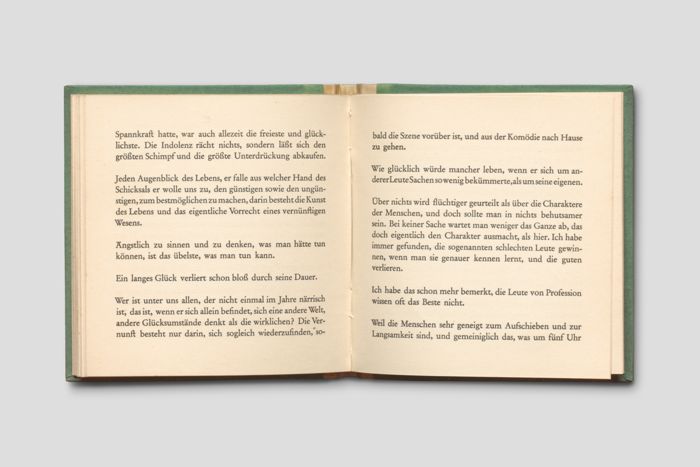
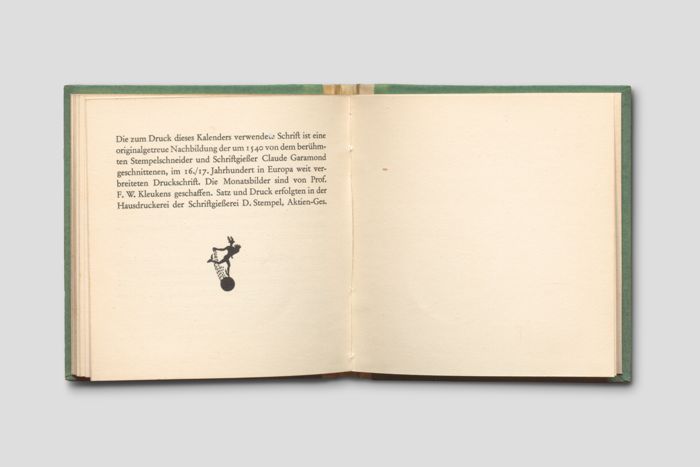
The almost square format of the thread-bound volume is reflected in the composition of the inside pages, which use only black ink. Each double page shows one month: on the right is a two-column calendar with holidays and the phases of the moon, and on the left is an illustration matching the respective season. The silhouette-like drawings are by Friedrich Wilhelm Kleukens (1878–1956). The last part of the book contains aphorisms by Georg Christoph Lichtenberg (1742–1799).
The calendar was set in Garamond Antiqua, now known as Stempel Garamond. This interpretation of the sixteenth-century typeface was created by D. Stempel under the direction of typographer Rudolf Wolf (1895–1942). It is considered a particularly faithful reproduction of the humanistic Antiqua typeface designed by French type cutter Claude Garamond (between 1490 and 1510–1561). The type foundry emphasized that its version was based on Garamond’s original prints.
Title
Calendar for the year 1926
Involved in the execution
D. Stempel AG (Production) GND
Rudolf Wolf (Type designer) GND
Friedrich Wilhelm Kleukens (Illustration) GND
Date
1926 (Production)
Geographical reference
Place of production: Frankfurt am Main
Material / Technique
Print, monochrome black on paper; cardboard cover with gold embossing; thread binding
Dimensions
Overall:
closed: 10,1 × 9,6 × 0,7 cm
Object type
Collection
Inventory number
19497-D.VIII.4.7
Creditline
Museum Angewandte Kunst, Frankfurt am Main
Accession
Donation; 31.12.1957; Charlotte Müller (born Albinus)
- Key: 08e949a5-2b22-429e-b23a-9353c617bcaf
- Module_ref: collection
- Create_date: 2025-12-03T12:39:10Z
- Change_date: 2026-07-24T10:00:21Z
- Sync_date: 2026-10-18T20:49:34Z
- Container_S: Buchkunst und Grafik
- InventoryNumber_S: 19497-D.VIII.4.7
- InventoryNumber_S_sort: 19497-D.VIII.4.7
- SimpleSearch: 19497-D.VIII.4.7,1926,Print, monochrome black on paper; cardboard cover with gold embossing; thread binding,Charlotte Müller (born Albinus),Typography, Graphic design, Script and type forms, Social stationery,Rudolf,Friedrich Wilhelm,D. Stempel AG;;Wolf;;Kleukens,Calendars,Brochures,Kalender für das Jahr 1926,Calendar for the year 1926,Europe/Germany/Hesse/Frankfurt am Main,Europe;;Germany;;Hesse;;Frankfurt am Main,Paper,Cardboard,Gold,Printing (process),Printing (process),Book binding,Embossing,D. Stempel AG,D. Stempel AG,Frankfurt am Main,Wolf,Rudolf,Wolf, Rudolf,Kleukens,Friedrich Wilhelm,Kleukens Friedrich Wilhelm,Achim bei Bremen,Nürtingen,The booklet’s plain cover made of green and off-white paper recedes behind an elaborate gold embossing. An intertwined monogram consisting of the letters “D” and “S” is framed by stars in outline and enclosed by a circular text: “Calendar for the year 1926.” It was published by the Frankfurt type foundry D. Stempel. Calendars like this served as a calling card to showcase the quality of typographic and printmaking craftsmanship and to promote new typefaces.<br class="linefeed" /><br class="linefeed" />The almost square format of the thread-bound volume is reflected in the composition of the inside pages, which use only black ink. Each double page shows one month: on the right is a two-column calendar with holidays and the phases of the moon, and on the left is an illustration matching the respective season. The silhouette-like drawings are by Friedrich Wilhelm Kleukens (1878–1956). The last part of the book contains aphorisms by Georg Christoph Lichtenberg (1742–1799).<br class="linefeed" /><br class="linefeed" />The calendar was set in Garamond Antiqua, now known as Stempel Garamond. This interpretation of the sixteenth-century typeface was created by D. Stempel under the direction of typographer Rudolf Wolf (1895–1942). It is considered a particularly faithful reproduction of the humanistic Antiqua typeface designed by French type cutter Claude Garamond (between 1490 and 1510–1561). The type foundry emphasized that its version was based on Garamond’s original prints.
- SimpleSearch2: 19497-D.VIII.4.7,1926,Print, monochrome black on paper; cardboard cover with gold embossing; thread binding,Charlotte Müller (born Albinus),Typography, Graphic design, Script and type forms, Social stationery,Rudolf,Friedrich Wilhelm,D. Stempel AG;;Wolf;;Kleukens,Calendars,Brochures,Kalender für das Jahr 1926,Calendar for the year 1926,Europe/Germany/Hesse/Frankfurt am Main,Europe;;Germany;;Hesse;;Frankfurt am Main,Paper,Cardboard,Gold,Printing (process),Printing (process),Book binding,Embossing,D. Stempel AG,D. Stempel AG,Frankfurt am Main,Wolf,Rudolf,Wolf, Rudolf,Kleukens,Friedrich Wilhelm,Kleukens Friedrich Wilhelm,Achim bei Bremen,Nürtingen,The booklet’s plain cover made of green and off-white paper recedes behind an elaborate gold embossing. An intertwined monogram consisting of the letters “D” and “S” is framed by stars in outline and enclosed by a circular text: “Calendar for the year 1926.” It was published by the Frankfurt type foundry D. Stempel. Calendars like this served as a calling card to showcase the quality of typographic and printmaking craftsmanship and to promote new typefaces.<br class="linefeed" /><br class="linefeed" />The almost square format of the thread-bound volume is reflected in the composition of the inside pages, which use only black ink. Each double page shows one month: on the right is a two-column calendar with holidays and the phases of the moon, and on the left is an illustration matching the respective season. The silhouette-like drawings are by Friedrich Wilhelm Kleukens (1878–1956). The last part of the book contains aphorisms by Georg Christoph Lichtenberg (1742–1799).<br class="linefeed" /><br class="linefeed" />The calendar was set in Garamond Antiqua, now known as Stempel Garamond. This interpretation of the sixteenth-century typeface was created by D. Stempel under the direction of typographer Rudolf Wolf (1895–1942). It is considered a particularly faithful reproduction of the humanistic Antiqua typeface designed by French type cutter Claude Garamond (between 1490 and 1510–1561). The type foundry emphasized that its version was based on Garamond’s original prints.
- InventoryNumberSearch_S: 19497-D.VIII.4.7
- IvNO_S: 19497-D.VIII.4.7
- AcquisitionDate_S: 31.12.1957
- MainTitle_S: Calendar for the year 1926
- MainTitle_S_sort: Calendar for the year 1926
- DatingType_S: Herstellung | Production
- Dating_S: 1926
- Dating_S2: 1926
- YearFrom_I: 1926
- YearTo_I: 1926
- Copyright_S: Urheberrechtsschutz - Rechteinhaber nicht auffindbar oder identifizierbar
- Creditline_S: Museum Angewandte Kunst, Frankfurt am Main
- Systematic_S: Graphic Design
- Systematic_multi_facet: Graphic Design
- Systematic_multi_facet_filter: Graphic Design
- MaterialTechnique_S: Print, monochrome black on paper; cardboard cover with gold embossing; thread binding
- AcquisitionType_S: Donation
- AcquisitionFrom_S: Charlotte Müller (born Albinus)
- Keywords_S: Typography, Graphic design, Script and type forms, Social stationery
- Keywords_multi_facet: Typography;;Graphic design;;Script and type forms;;Social stationery
- Keywords_multi_facet_filter: Typography;;Graphic design;;Script and type forms;;Social stationery
- Materials_multi_facet: Paper;;Cardboard;;Gold
- Materials_multi_facet_filter: Paper;;Cardboard;;Gold
- Techniques_multi_facet: Printing (process);;Printing (process);;Book binding;;Embossing
- Techniques_multi_facet_filter: Printing (process);;Printing (process);;Book binding;;Embossing
- Subjects_FirstName_multi_facet: Rudolf,Friedrich Wilhelm
- Subjects_FirstName_multi_facet_filter: Rudolf,Friedrich Wilhelm
- Subjects_Name_multi_facet: D. Stempel AG;;Wolf;;Kleukens
- Subjects_Name_multi_facet_filter: D. Stempel AG;;Wolf;;Kleukens
- Subjects_FullName_multi_facet: D. Stempel AG;;Rudolf Wolf;;Friedrich Wilhelm Kleukens
- Subjects_FullName_multi_facet_filter: D. Stempel AG;;Rudolf Wolf;;Friedrich Wilhelm Kleukens
- Subjects_NameSorted_multi_facet: D. Stempel AG;;Wolf, Rudolf;;Kleukens, Friedrich Wilhelm
- Subjects_NameSorted_multi_facet_filter: D. Stempel AG;;Wolf, Rudolf;;Kleukens, Friedrich Wilhelm
- lists_s: ObjectNames,Titles,GeographicReferences,Materials,Techniques,Datings,Subjects,Texts,Dimensions,WebLinks,Media
- list_ObjectNames_I: 2
- ObjectNames_Type_0_S: Obj.bez.
- ObjectNames_Text_0_S: Calendars
- ObjectNames_Type_1_S: Obj.bez. (alternativ)
- ObjectNames_Text_1_S: Brochures
- list_Titles_I: 2
- Titles_Type_0_S: Titel
- Titles_Text_0_S: Kalender für das Jahr 1926
- Titles_Text_S_sort: Kalender für das Jahr 1926
- TitleSearch: Kalender für das Jahr 1926,Calendar for the year 1926
- Titles_Type_1_S: Titel (englisch)
- Titles_Text_1_S: Calendar for the year 1926
- list_GeographicReferences_I: 1
- GeographicReferences_Type_0_S: Herstellungsort | Place of production
- GeographicReferences_Text_0_S: Europe/Germany/Hesse/Frankfurt am Main
- GeographicReferences_Text_0_multi_facet: Europe;;Germany;;Hesse;;Frankfurt am Main
- GeographicReferences_Text_0_multi_facet_filter: Europe;;Germany;;Hesse;;Frankfurt am Main
- list_Materials_I: 3
- Materials_Type_0_S: Material
- Materials_Text_0_S: Paper
- Materials_Type_1_S: Material
- Materials_Text_1_S: Cardboard
- Materials_Type_2_S: Material
- Materials_Text_2_S: Gold
- list_Techniques_I: 4
- Techniques_Type_0_S: Technik
- Techniques_Text_0_S: Printing (process)
- Techniques_Type_1_S: Technik
- Techniques_Text_1_S: Printing (process)
- Techniques_Type_2_S: Technik
- Techniques_Text_2_S: Book binding
- Techniques_Type_3_S: Technik
- Techniques_Text_3_S: Embossing
- list_Datings_I: 0
- list_Subjects_I: 3
- Subjects_Role_0_S: Production
- Subjects_Key_0_S: a8200976-707f-4781-a506-522d9e1c9f9c
- Subjects_Type_0_S: Körperschaft
- Subjects_Name_0_S: D. Stempel AG
- Subjects_SortedName_0_S: D. Stempel AG
- Subjects_S_sort: D. Stempel AG
- Subjects_Dating_0_S: 1905-1985
- Subjects_PlaceOfBirth_0_S: Frankfurt am Main
- Subjects_UriGnd_0_S: http://d-nb.info/gnd/4348871-7
- Subjects_Role_1_S: Type designer
- Subjects_Key_1_S: eb035421-235f-486a-919c-7a148c90e773
- Subjects_Type_1_S: Person
- Subjects_Name_1_S: Wolf
- Subjects_FirstName_1_S: Rudolf
- Subjects_SortedName_1_S: Wolf, Rudolf
- Subjects_Dating_1_S: 1877-1940
- Subjects_UriGnd_1_S: http://d-nb.info/gnd/1043111239
- Subjects_Role_2_S: Illustration
- Subjects_Key_2_S: 771a7a03-a793-4b7b-a99c-8d26eb50ee5c
- Subjects_Type_2_S: Person
- Subjects_Name_2_S: Kleukens
- Subjects_FirstName_2_S: Friedrich Wilhelm
- Subjects_SortedName_2_S: Kleukens Friedrich Wilhelm
- Subjects_Dating_2_S: 1878 - 1956
- Subjects_PlaceOfBirth_2_S: Achim bei Bremen
- Subjects_PlaceOfDeath_2_S: Nürtingen
- Subjects_DayOfBirth_2_S: 07.05.1878
- Subjects_DayOfDeath_2_S: 22.08.1956
- Subjects_UriGnd_2_S: http://d-nb.info/gnd/116227117
- list_Texts_I: 1
- Texts_Type_0_S: Web (englisch)
- Texts_Language_0_S: EN
- Texts_LongText_0_S: The booklet’s plain cover made of green and off-white paper recedes behind an elaborate gold embossing. An intertwined monogram consisting of the letters “D” and “S” is framed by stars in outline and enclosed by a circular text: “Calendar for the year 1926.” It was published by the Frankfurt type foundry D. Stempel. Calendars like this served as a calling card to showcase the quality of typographic and printmaking craftsmanship and to promote new typefaces.<br class="linefeed" /><br class="linefeed" />The almost square format of the thread-bound volume is reflected in the composition of the inside pages, which use only black ink. Each double page shows one month: on the right is a two-column calendar with holidays and the phases of the moon, and on the left is an illustration matching the respective season. The silhouette-like drawings are by Friedrich Wilhelm Kleukens (1878–1956). The last part of the book contains aphorisms by Georg Christoph Lichtenberg (1742–1799).<br class="linefeed" /><br class="linefeed" />The calendar was set in Garamond Antiqua, now known as Stempel Garamond. This interpretation of the sixteenth-century typeface was created by D. Stempel under the direction of typographer Rudolf Wolf (1895–1942). It is considered a particularly faithful reproduction of the humanistic Antiqua typeface designed by French type cutter Claude Garamond (between 1490 and 1510–1561). The type foundry emphasized that its version was based on Garamond’s original prints.
- list_Dimensions_I: 1
- Dimensions_Type_0_S: Objektmaß | Overall
- Dimensions_Dimension_0_S: geschlossen: | closed: || 10,1 x 9,6 x 0,7 cm
- list_WebLinks_I: 0
- list_Media_I: 11
- Media_Key_0_s: 61c205f1-13bb-4779-9fad-e37c5bc22043
- Media_Type_0_S: Bild
- Media_Rightsholder_0_S: Museum Angewandte Kunst
- Media_Credits_0_S: © Museum Angewandte Kunst, Frankfurt am Main
- Media_Key_1_s: 44232d0f-6e96-4e01-bda9-50c5b5c91631
- Media_Type_1_S: Bild
- Media_Rightsholder_1_S: Museum Angewandte Kunst
- Media_Credits_1_S: © Museum Angewandte Kunst, Frankfurt am Main
- Media_Key_2_s: d7879d01-1583-4dca-9a1d-180262407417
- Media_Type_2_S: Bild
- Media_Rightsholder_2_S: Museum Angewandte Kunst
- Media_Credits_2_S: © Museum Angewandte Kunst, Frankfurt am Main
- Media_Key_3_s: 71c4ee0f-9682-43ee-b2d5-bc2b9804e960
- Media_Type_3_S: Bild
- Media_Rightsholder_3_S: Museum Angewandte Kunst
- Media_Credits_3_S: © Museum Angewandte Kunst, Frankfurt am Main
- Media_Key_4_s: 443b8795-c31b-4a8b-9c2c-c3d879b2ef01
- Media_Type_4_S: Bild
- Media_Rightsholder_4_S: Museum Angewandte Kunst
- Media_Credits_4_S: © Museum Angewandte Kunst, Frankfurt am Main
- Media_Key_5_s: 4b3adb06-5296-4326-9862-b5d7be6fefae
- Media_Type_5_S: Bild
- Media_Rightsholder_5_S: Museum Angewandte Kunst
- Media_Credits_5_S: © Museum Angewandte Kunst, Frankfurt am Main
- Media_Key_6_s: b7b70e5f-c265-4a63-beb5-2cf71efe786c
- Media_Type_6_S: Bild
- Media_Rightsholder_6_S: Museum Angewandte Kunst
- Media_Credits_6_S: © Museum Angewandte Kunst, Frankfurt am Main
- Media_Key_7_s: bfc60ed7-2c2d-4462-814d-c2be5615450f
- Media_Type_7_S: Bild
- Media_Rightsholder_7_S: Museum Angewandte Kunst
- Media_Credits_7_S: © Museum Angewandte Kunst, Frankfurt am Main
- Media_Key_8_s: 13e33090-9bd7-40d9-9a4a-b9e910a3d0f6
- Media_Type_8_S: Bild
- Media_Rightsholder_8_S: Museum Angewandte Kunst
- Media_Credits_8_S: © Museum Angewandte Kunst, Frankfurt am Main
- Media_Key_9_s: 5e54fe9d-fde0-491e-8479-1496e4085aa3
- Media_Type_9_S: Bild
- Media_Rightsholder_9_S: Museum Angewandte Kunst
- Media_Credits_9_S: © Museum Angewandte Kunst, Frankfurt am Main
- Media_Key_10_s: aaca7acb-9f18-4169-a9db-101a141cac71
- Media_Type_10_S: Bild
- Media_Rightsholder_10_S: Museum Angewandte Kunst
- Media_Credits_10_S: © Museum Angewandte Kunst, Frankfurt am Main
- _version_: 1879422841235964000
- lists: [object Object]

